How to Reset Your Mini Split — Step by Step
One reset attempt is always worth trying before calling. Here's the correct sequence:
- Turn the unit off using the remote — press the power button and confirm the display goes dark.
- Find the circuit breaker for the mini split in your main electrical panel — it's usually labeled "AC," "Mini Split," or "HVAC." Flip it to the OFF position.
- Wait exactly 5 minutes. This lets the capacitors discharge and the control board fully reset.
- Flip the breaker back to ON.
- Wait 3 more minutes before turning the unit on — this gives the refrigerant pressure time to equalize.
- Turn the unit on using the remote. Set it to COOL mode, target temperature at least 6°F below the current room temperature.
- Wait 15 minutes. If the air coming out is still warm — or if the breaker trips again immediately — stop. Call us. Do not reset again.
Repeated resets on a unit with a failing capacitor or low refrigerant can overheat the compressor windings. A $350 capacitor job becomes a $1,400 compressor job if the unit is forced to start repeatedly against resistance.
What Temperature Should a Mini Split Blow at When Working?
A properly working mini split in COOL mode should produce air between 15°F and 20°F colder than the room temperature at the intake. Here's what that means in practice for a West Palm Beach home:
- Room temperature 82°F → air from vents should feel 62°F to 67°F
- Room temperature 78°F → air from vents should feel 58°F to 63°F
- Room temperature 90°F (unit was off all day) → air should feel 70°F to 75°F
If the air feels only slightly cool — 5°F to 8°F colder than room temp — the unit is working but not performing. The most common cause in WPB: a coil coated in salt deposits or a refrigerant charge that's low from a slow coastal leak. Both are fixable. Neither fixes itself.
R-22 vs R-410A — What WPB Homeowners Need to Know
Refrigerant type matters for cost and repairability, especially in West Palm Beach where coastal corrosion causes leaks more often than in drier climates.
R-410A is the standard refrigerant in all mini splits manufactured after 2010. It's available, EPA-compliant, and a recharge costs $200 to $600 depending on how much was lost. Salt air corrosion on copper line fittings is the most common cause of R-410A leaks in WPB.
R-22 was phased out of production in the US in 2020 under the Clean Air Act. If your system is older than 2010 and uses R-22, recharging it now costs $50 to $150 per pound — and that cost will only rise as existing stockpiles shrink. A typical mini split holds 2 to 4 pounds. A recharge that cost $150 in 2015 now costs $300 to $600 — and there's no long-term supply. If you have an R-22 system and it's leaking, get a replacement quote alongside the repair estimate.
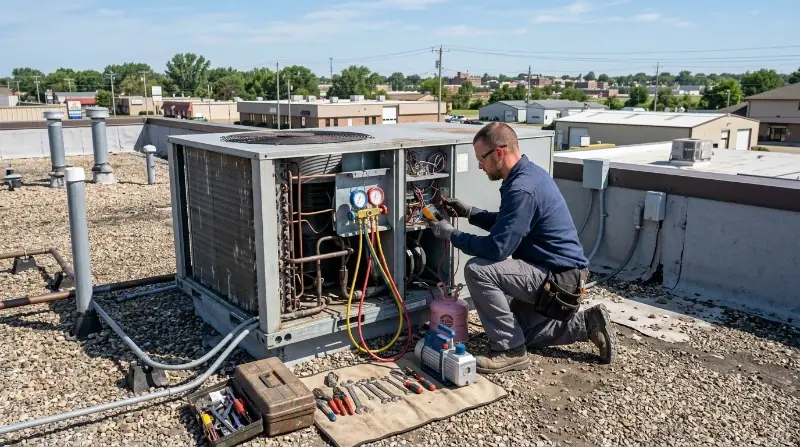
To find your refrigerant type: check the label on the outdoor condenser unit. It will say "R-22" or "R-410A" clearly. If the label is missing, your licensed tech can identify it from the service port fittings.
How to Tell If Your Evaporator Coil Is Dirty
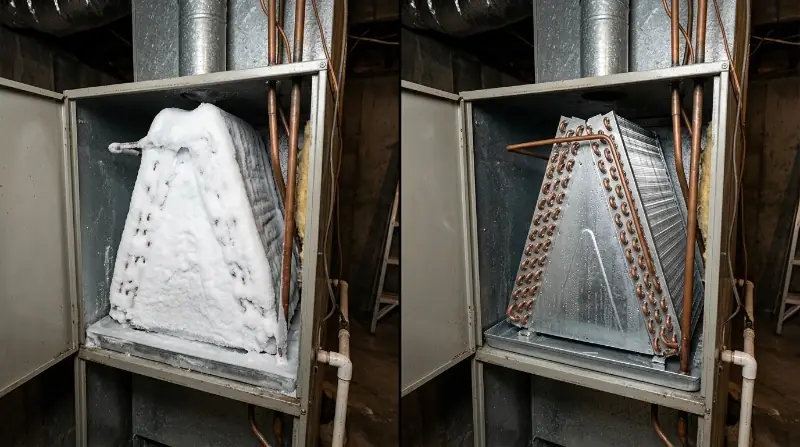
You can check this yourself without a technician. Turn the unit off and open the front panel of the indoor head unit — on most mini splits, the panel lifts up from the bottom edge. Behind the air filter, you'll see the evaporator coil: a series of thin aluminum fins arranged in rows.
- Clean coil: Fins are clearly visible, silver or light gray, with visible space between each fin. Air passes through freely.
- Dirty coil: Fins are coated in a gray-white crust — that's salt deposits, dust, and biological buildup. Individual fins may be stuck together. Some fins may be bent from previous cleaning attempts.
- WPB-specific sign: A white or slightly greenish residue on the fins indicates salt deposits from the Intracoastal air. This is more common in El Cid, SoSo, and Flamingo Park homes than in inland WPB neighborhoods.
A coil coated in deposits loses 5% to 15% of its cooling efficiency per inch of buildup depth. A unit that should cool a room to 72°F in 20 minutes may take 40 to 45 minutes with a heavily fouled coil — and the compressor runs continuously, wearing faster and driving up the FPL bill.
Salt Air Corrosion — How to Slow It Down
Salt air from Lake Worth Lagoon and the Atlantic moves through WPB neighborhoods constantly. You can't eliminate the exposure — but you can slow the damage with three practical steps:
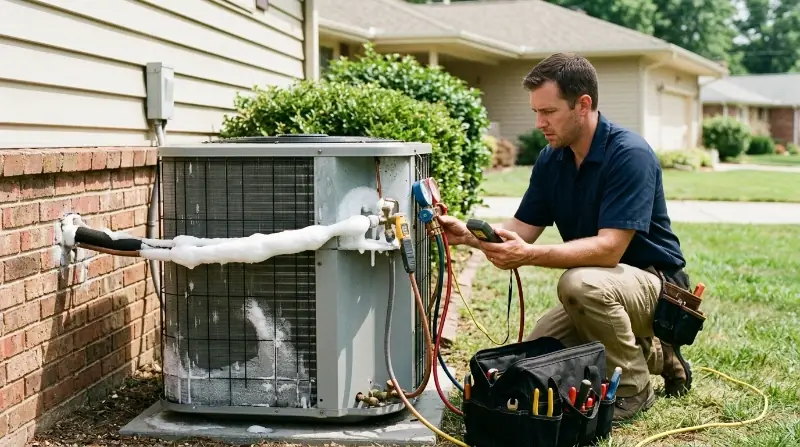
- Annual coil cleaning on the outdoor unit: Rinse the outdoor condenser fins with a gentle garden hose spray from inside out — not a pressure washer, which bends the fins. This removes salt deposits before they start etching the aluminum. For homes within half a mile of the Intracoastal, do this every 6 months.
- Coil coating (optional but effective): A licensed tech can apply a clear polymer coating to the outdoor condenser coil after cleaning. It costs $80 to $150 and significantly slows salt corrosion for 12 to 18 months.
- Refrigerant line inspection annually: The copper line set running between your indoor and outdoor units is the most vulnerable point. Salt air corrodes the fittings at the connection points. A visual inspection catches early corrosion before it becomes a refrigerant leak.
DIY vs Professional Diagnosis Checklist
Check these yourself before calling. If any item below passes — move to the next one. If any item fails — that's likely your cause.
| Check |
What to look for |
If it fails |
| Remote mode | Display shows COOL, not FAN, DRY, or HEAT | Change mode — done, no call needed |
| Target temp | Set temp is at least 6°F below current room temp | Lower set temp — done, no call needed |
| Air filter | Remove filter — should be light gray, not dark gray or black | Rinse filter, reinstall, test for 20 minutes |
| Drain pan | Check under indoor head for standing water | Drain line clog — call us, $85–$180 fix |
| Outdoor unit | Outdoor fan spinning, 18-inch clearance on all sides | Clear obstructions; if fan not spinning, call us |
| Circuit breaker | Breaker in ON position, not tripped (middle position) | Reset once. If trips again: call us |
| Vents | Indoor louvers are open and swinging freely | Check for object blocking the louver motor |
If all of these pass and the unit still blows warm air — the problem is refrigerant, capacitor, or coil. All three need a licensed tech. Call (877) 666-6760 — same-day diagnosis.
When to Call vs When to Wait
Not every warm-air situation is an emergency. Here's how to decide:
- Call same day: Indoor temperature above 85°F, anyone elderly or under 5 in the home, pet birds or reptiles (both highly temperature-sensitive), water leaking from the unit, breaker tripping repeatedly, burning smell from any part of the system.
- Call within 24 hours: Unit runs but can't get below 78°F, unusual noise started recently, FPL bill spiked last month, drain line hasn't been cleaned in over 6 months.
- Try DIY first: Air filter is clearly clogged, remote is in wrong mode, outdoor unit is blocked by debris, unit was recently moved or remounted and may be out of level.